
Live
Task Monitoring
Watch every orchestrated task plan execute in real time. Nodes recolor as sub-agents start, finish, fail, or are skipped — so users see exactly what their AI is doing, not just the final answer.
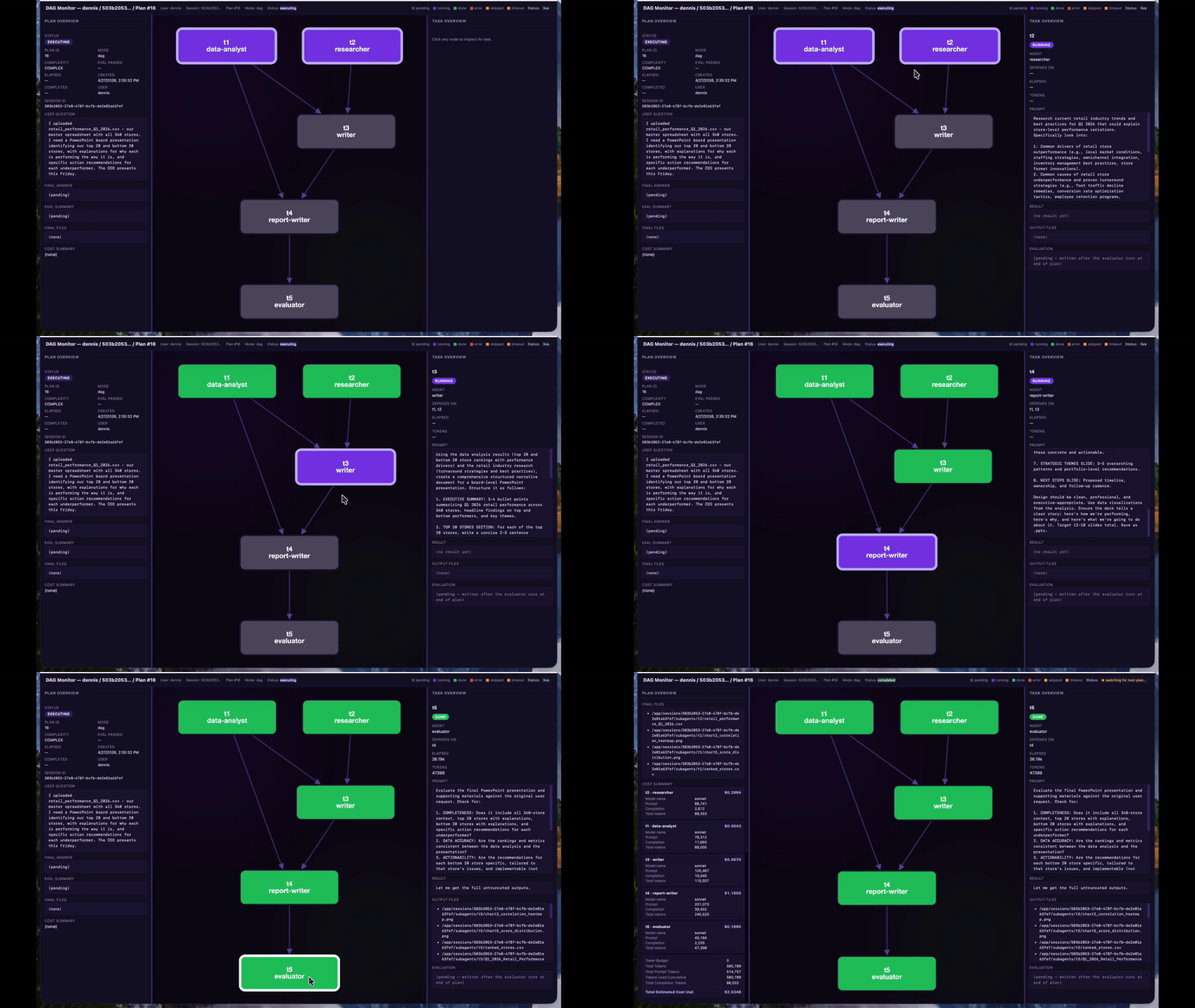
A Directed Acyclic Graph
is a Workflow's Blueprint
A directed acyclic graph (DAG) is a graph whose edges all point in one direction and that contains no cycles — once you leave a node by following the arrows, no sequence of edges can ever bring you back to it. That single property makes DAGs the natural language for representing dependencies.
DAGs are how modern systems describe the order things must happen in: compilers schedule code, build tools resolve dependencies, version-control systems track history, spreadsheets recalculate cells, and data pipelines plan their stages. Whenever "B can only run after A finishes" is the rule, a DAG is the right shape.
NvAgent uses the same shape. The orchestrator decomposes a complex request into tasks, declares the dependencies between them, and the resulting DAG becomes both the execution plan and the live picture you see on this page.
Five Colors. One Source of Truth.
Every node in the graph carries one of five live states. The color updates the moment the orchestrator changes the task's status in PostgreSQL — no polling, no refresh button.
Postgres LISTEN/NOTIFY + SSE
The monitor uses what NvAgent already has — the orchestrator writes status to Postgres, Postgres pushes those changes to the API, and the API streams them to the browser. No queue, no broker, no extra service.
A single pg_notify inside the same transaction that updates the task — under one millisecond on the user's request path.
Zero added latency
Each task state change is a single notify inside the existing UPDATE transaction. The orchestrator never blocks on a queue or a broker.
No new infrastructure
No Redis, no Kafka, no WebSocket gateway. Postgres and FastAPI are already in the stack — the monitor reuses both.
Kubernetes-native
Each pod opens its own LISTEN connection. Postgres delivers every notification to every replica, so the monitor scales horizontally with the API.
Back-pressure safe
The in-process fan-out uses bounded queues and drops the oldest event for slow clients, so a stuck browser tab cannot stall other consumers.
Auto-shutdown
The SSE stream closes itself shortly after the plan reaches a terminal state — no orphan connections, no manual cleanup.
Future-proof contract
The same LISTEN/NOTIFY contract makes it trivial to extract the monitor into its own service later without changing a line of orchestrator code.
Every Task. Every Verdict. Every Dollar.
The monitor isn't just a graph — it's an audit trail. Alongside the live DAG, a side panel shows per-task progress and a cost summary so users know not just what the agent did, but how well and at what price.
- Live status, model, and elapsed time per node
- Evaluator verdict badge: PASS / NEEDS IMPROVEMENT / FAIL
- Per-task token counts (prompt, completion, total)
- Plan-level cost summary with grand total
- Final response and generated files when the plan completes
- Shareable URL per plan or per user session
Built On Our AI Code of Ethics
The DAG Monitor isn't a cosmetic add-on — it's how we honor specific commitments from Notovision's AI Code of Ethics. Showing the work is how we earn confidence.
Communicate the plan, then keep users informed
The monitor publishes the orchestrator's plan the moment it's created and streams every status change live. Users see the strategy before execution and watch each step happen.
Cite sources and explain methods
Every node names the sub-agent that ran it, the model it used, the tools it called, and the cost it incurred — the full provenance of each piece of the answer is visible.
Never guess — show verified work
The evaluator's verdict (PASS / NEEDS IMPROVEMENT / FAIL) and numeric score appear next to every task. Users see the quality gate, not just the output.
Acknowledge limits plainly
Failed and skipped nodes stay on the graph, color-coded and labeled. Nothing is hidden when something doesn't work — the gaps in the answer are part of the answer.
Strong data stewardship
Every plan, task, evaluator score, and cost record is persisted to PostgreSQL. The monitor is replaying a durable audit log, not an ephemeral feed.
Transparent that this is an AI
The DAG visibly shows specialized AI sub-agents collaborating — data analysts, researchers, writers, evaluators. The mechanism is the message.
See the Work, Not Just the Answer
Live
The DAG Monitor turns sub-agent orchestration from a black box into a glass house. Every plan, every step, every score — visible the instant it happens.
Sub-Agent Orchestration → Our AI Code of Ethics